

Surging demand for AI data centers has driven significant appreciation in the stock prices of semiconductor companies across the value chain. In this series, we’ll break down Nvidia’s GB200 supply chain to map which components and suppliers have captured the data center build-out, and why the market has repriced certain names along the way.
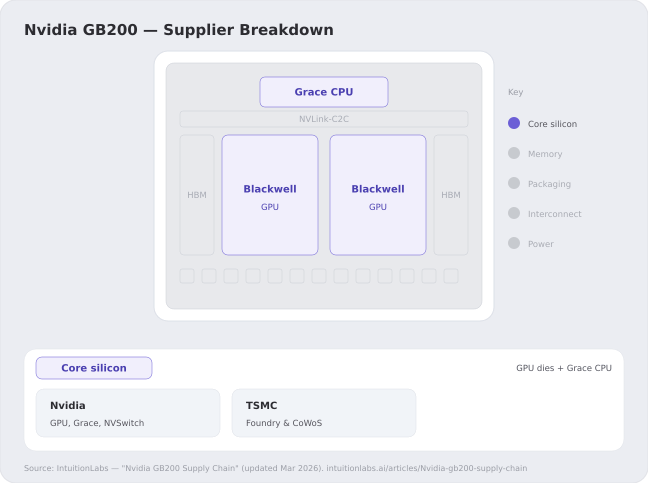
The Nvidia GB200 Superchip is built around two Blackwell GPUs and a Grace CPU. Together, these processing units perform trillions of calculations per second, supporting the training and inference of models that generate text, images, and other content. However, beyond chip design, Nvidia’s actual advantage lies in software. PyTorch, TensorFlow, and other software underpinning modern AI hug tightly around Nvidia’s CUDA stack, making it the default environment for developing and deploying AI models. Rivals can design competitive hardware, but replicating CUDA’s developer and library footprint is a different problem.
CoWoS (Chip-on-Wafer-on-Substrate)
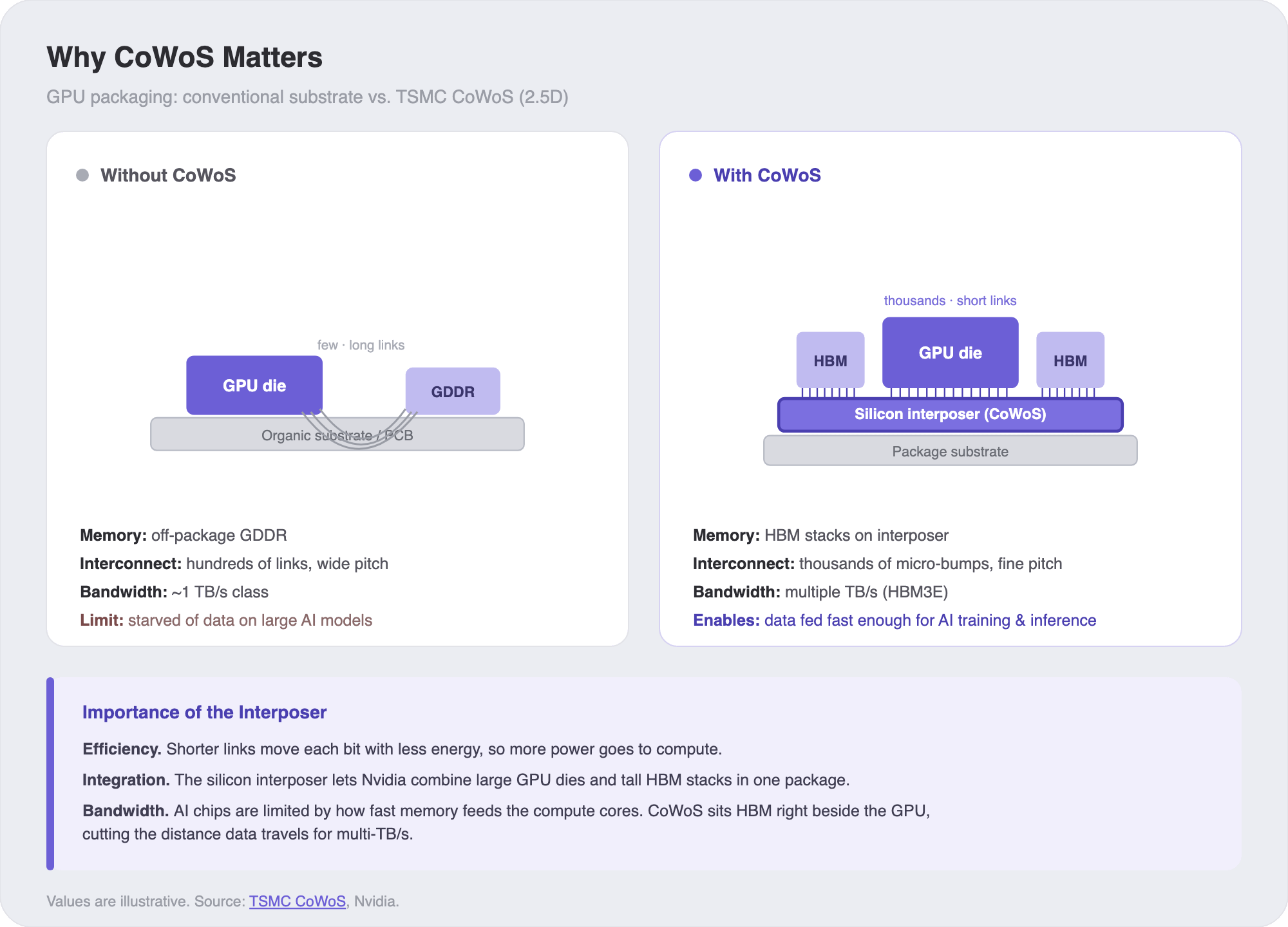
While Nvidia designs chips, physical manufacturing is handled by TSM 0.00%↑ . In particular, Nvidia relies on TSMC’s proprietary packaging process, CoWoS, which integrates a GPU and its memory side by side with fast, short connections between them.

Today, nearly all leading-edge CoWoS capacity still sits in Taiwan, and slots are typically booked 52 to 78 weeks in advance. Without CoWoS, large models with up to trillions of parameters would struggle to achieve the performance levels required for commercial deployment.
Data Center Revenue
NVDA 0.00%↑’s data center revenue grew every quarter over the past two fiscal years, climbing from $22.6 billion to $62.3 billion:
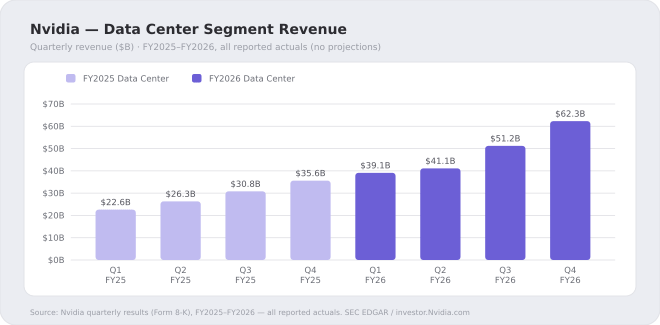
Demand reached a clear inflection point in Q3 FY2026 as cloud providers raced to secure GPU capacity and supply tightened across the semiconductor supply chain. But the GPU itself is only one part of the story. The GB200 platform depends on a complex web of suppliers who provide components ranging from memory and networking to power and cooling; when assembled, they enable the hyperscale infrastructure buildout behind the revenue curve shown above.